Viofo A119 V3 Review: Is a Front-Only 2K Dash Cam Still Worth It in 2026?
Published October 21, 2026
As an Amazon Associate we earn from qualifying purchases. This never changes which products we recommend.
Verdict
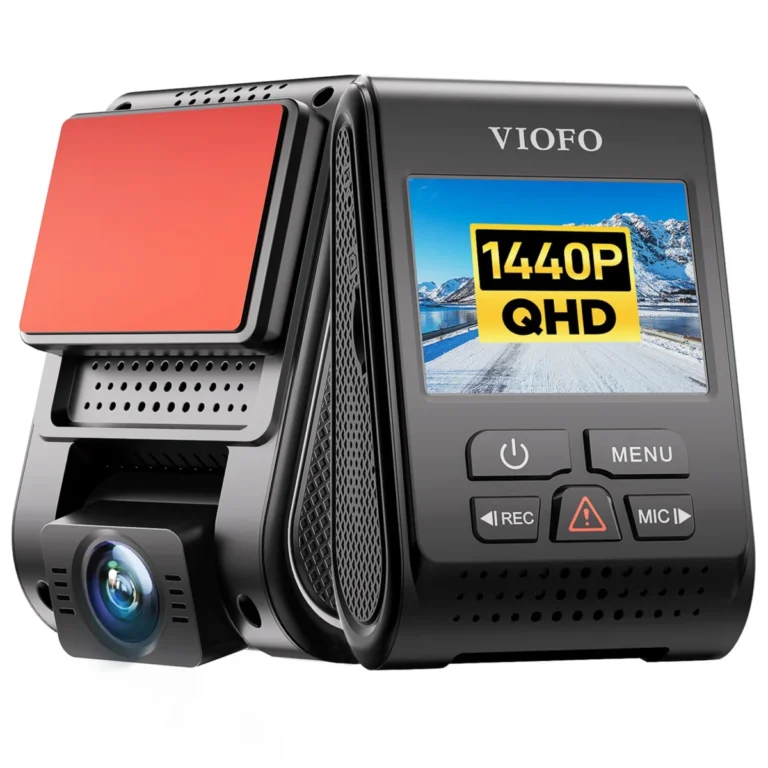
Worth considering
The Viofo A119 V3 is a sound buy for a driver who wants one dependable front camera with 2K detail, built-in GPS and heat-tolerant supercapacitor power, and who does not need rear coverage or phone control. Its decisive limits are the absence of Wi-Fi and app transfer and the fact that parking mode only works with a separately sold hardwire kit.
- Best for: Commuters who want one reliable front camera and no rear coverage, Drivers in hot climates who prefer supercapacitor power over a lithium battery, Owners of older cars who want a discreet, screen-equipped camera without app pairing
- Not for: Rideshare, taxi and fleet drivers who need interior or rear coverage, Buyers who expect Wi-Fi clip transfer to a phone
Key takeaways
- The A119 V3 records the front road only, at 2K (1440p) up to 60 fps, so it does not cover rear or interior risk.
- Buffered parking mode needs the separately sold VIOFO HK3 hardwire kit, which adds cost and installation effort.
- A supercapacitor instead of a lithium battery makes the A119 V3 the more sensible choice for hot climates.
- There is no Wi-Fi and no app, so footage is retrieved by removing the microSD card.
Table of contents11 sections · tap to expand
The Viofo A119 V3 is a single-channel dash cam that records the road ahead at 2K (1440p) on a Sony STARVIS IMX335 sensor, with a 140-degree lens, built-in GPS and a supercapacitor for power. It mounts on the windshield with an adhesive quick-release base and records to a microSD card up to 256 GB.
This viofo a119 v3 review answers the question most buyers now ask: is a front-only 2K camera still worth it? For a driver whose risk is the road ahead, yes. The A119 V3 is worth buying if you want clean 2K footage, GPS logging and heat tolerance without paying for channels or connectivity you will not use. If you need rear coverage, phone transfer or parking protection out of the box, it is the wrong camera.
Specifications
Key specifications
| Specification | Detail | Why it matters |
|---|---|---|
| Channels | 1 (front only) | It protects the road ahead but leaves rear and interior incidents uncovered. |
| Front video | 2K (1440p) | 1440p gives enough detail to read plates and road signs in most daytime conditions. |
| Sensor | Sony STARVIS (IMX335) | The STARVIS sensor is built for low light, which is where plate legibility is usually lost. |
| Frame rate | 60 fps (max) | 60 fps captures fast motion more cleanly, but HDR drops the camera to 30 fps. |
| Field of view | 140° | A 140-degree lens covers multiple lanes with less edge distortion than wider lenses. |
| Parking mode | Yes (buffered, time-lapse, low bitrate) | Buffered recording saves the seconds before an impact, but only with a hardwire kit. |
| Max storage | 256 GB microSD | 256 GB holds many hours of loop recording before older clips are overwritten. |
Is the A119 V3 good value for a front-only setup?
For a front-only setup, the A119 V3 concentrates its cost on the parts that matter: a STARVIS sensor, 2K recording, built-in GPS and a supercapacitor. You are not paying for a rear camera, a screen-heavy interface or cloud features. The extras that do add cost are the hardwire kit for parking mode and the optional CPL filter, and both are worth it only if you will use them.
Buyer ratings for the A119 V3 are very positive across a very large number of buyers, which fits a camera that has been a common choice for years. The honest limit is that newer single-channel cameras exist with features this one lacks, so compare on the features you actually need rather than assuming newer is better for your use.
How good is the A119 V3 video at night and in motion?
Night footage is where the A119 V3 earns its place: the Sony STARVIS IMX335 sensor is designed for low light, and HDR mode brightens shadow detail when the camera records at 30 fps. At 60 fps the camera gives up HDR in exchange for smoother capture of fast movement, which helps with plates on passing traffic in daylight.
Resolution alone does not decide whether a plate is readable. Distance, headlight glare, windshield dirt and the angle between camera and plate all matter, and a 140-degree lens spreads detail across a wide frame. Expect a good chance of reading a close, lit plate at night rather than a guarantee, and keep the glass clean in front of the lens.
What does the A119 V3 record, and what does it leave out?
The A119 V3 records one channel, the road ahead, so a rear-end hit from behind or an incident in a parking lot behind the car is not captured. That is the tradeoff of a single-channel camera: fewer parts, a simpler install and a lower price, in exchange for narrower coverage.
If your risk is mostly the car in front braking hard, a lane change into your path or a disputed junction, front-only coverage answers the question. If you carry passengers for hire or park on busy streets, rear and interior coverage change the decision, and this camera cannot be expanded into that role.
Does the A119 V3 need a hardwire kit for parking mode?
Yes. Parking mode on the A119 V3 runs only with the separately sold VIOFO HK3 ACC hardwire cable, which detects ignition state and cuts power if the car battery voltage falls too low. Plugged into the 12V socket alone, the camera records only while that socket stays live.
With the kit fitted, buffered parking mode keeps the seconds before and after an impact, and time-lapse and low-bitrate modes stretch storage across a long park. The kit is the one extra most owners should budget for, because a dash cam that sleeps in a car park misses the incidents parking mode exists to catch.
How do you install the A119 V3 and move clips off it?
Installation is straightforward: clean the glass, press the adhesive quick-release base onto the windshield, slide the camera in and route the power cable along the headliner to the 12V socket. The GPS mount is included, so speed, timestamp and route coordinates are stamped on the files without extra hardware.
Getting footage off the camera is manual. There is no Wi-Fi and no app, so you eject the microSD card and read it on a computer, which is slower than phone transfer when you need a clip at the roadside. Loop recording overwrites the oldest files, and the G-sensor locks event clips so a collision is not erased.
Who should buy the A119 V3 and who should skip it?
The A119 V3 fits a driver who wants one dependable front camera with 2K detail, built-in GPS and supercapacitor power, and who accepts that parking mode means adding the VIOFO HK3 hardwire kit.
Strengths and weaknesses
Pros and cons
Pros
- 2K (1440p) recording up to 60 fps on a Sony STARVIS IMX335 sensor
- Built-in GPS stamps speed, time and route data onto footage
- Supercapacitor power suits hot climates better than a lithium battery
- Buffered parking mode saves the 15 seconds before and 30 seconds after an event
- Adhesive quick-release mount with GPS and non-GPS bases included
- Supports microSD cards up to 256 GB
Cons
- Front-only, with no rear or interior channel
- Parking mode requires the separately sold VIOFO HK3 hardwire kit
- HDR recording drops the frame rate to 30 fps
See also: 7 Dash Cams Ranked for Commuters, Rideshare Drivers and Street Parkers; Viofo A229 Pro vs 70mai A810: Which 4K Dash Cam Fits Your Car.
Common questions
Frequently asked questions
Does the Viofo A119 V3 have Wi-Fi or an app?
No. The A119 V3 has no Wi-Fi and no companion app, so you review and export clips by removing the microSD card and reading it on a computer. That keeps the camera simple and the price down, but it is slower than phone transfer when you need a clip quickly.
What microSD card does the Viofo A119 V3 need and what capacity does it support?
The A119 V3 supports microSD cards up to 256 GB, and VIOFO recommends a U3 A2 V30 card. Choose a high-endurance model rated for continuous writing, because loop recording rewrites the card constantly and standard cards wear out sooner.
Can the A119 V3 run parking mode without a hardwire kit?
No. Parking mode on the A119 V3 requires the VIOFO HK3 ACC hardwire cable, sold separately, which switches the camera into parking mode on ignition and monitors voltage to protect the battery. Without it, the camera runs only while the 12V socket is powered.
How does the A119 V3 handle heat in summer?
The A119 V3 uses a supercapacitor instead of a lithium battery, which tolerates a hot parked car far better than a battery cell. It still needs airflow and sensible mounting out of direct sun, and it cannot run on its own reserve power.
Is the GPS module included or sold separately?
GPS is built into the A119 V3 and included with the camera, and the box includes a GPS mount. It records speed, timestamp and route coordinates onto the video files and syncs the camera clock from satellite time.
Is the A119 V3 good enough to read license plates at night?
The A119 V3 has a good chance of reading a plate at night when the car is close and lit, thanks to the STARVIS IMX335 sensor and HDR mode. A distant plate in fast motion at night is difficult for any single-channel camera, so treat plate reading as likely rather than guaranteed.
Bottom line
Should you buy the Viofo A119 V3?
It suits commuters, hot-climate drivers and owners of older cars who prefer a screen and a memory card over an app.
Skip it if you need rear or interior coverage, or if you expect to pull clips onto your phone. A single-channel camera cannot be expanded into a multi-channel one, so start with a camera that already records the channels you need rather than adding this one and hoping to grow it.
Keep reading
Rove R2 4K Review: Strong Front Footage, No Rear Camera
Is the Rove R2 4K worth it? Our review weighs front video resolution, night video and field of view, its pros and…
Garmin Dash Cam Mini 3 Review: What It Records, What It Misses, and Who Should Buy It
Garmin Dash Cam Mini 3 review: video resolution, night video and field of view, honest pros and cons, and a clear verdict…
How to Set Up Dash Cam Parking Mode: Wiring, Cutoff and Settings
To set up dash cam parking mode, give the camera a constant power source (a fused fuse-box connection or an OBD cable,…